The final release in Destiny 2's Light & Dark Saga, The Final Shape brought players into a dreamlike realm within the Traveler itself, where the history of the Destiny universe was warped and twisted by The Witness in a final attempt to shape the world to its own ends.
For this release, Neon served as a guide and mentor for the other Technical UX Designers on their team, implemented the destination's enormous map, and functioned as the sole UI implementer for the game's new Pathfinder pursuit system.
The Pale Heart of the Traveler Map
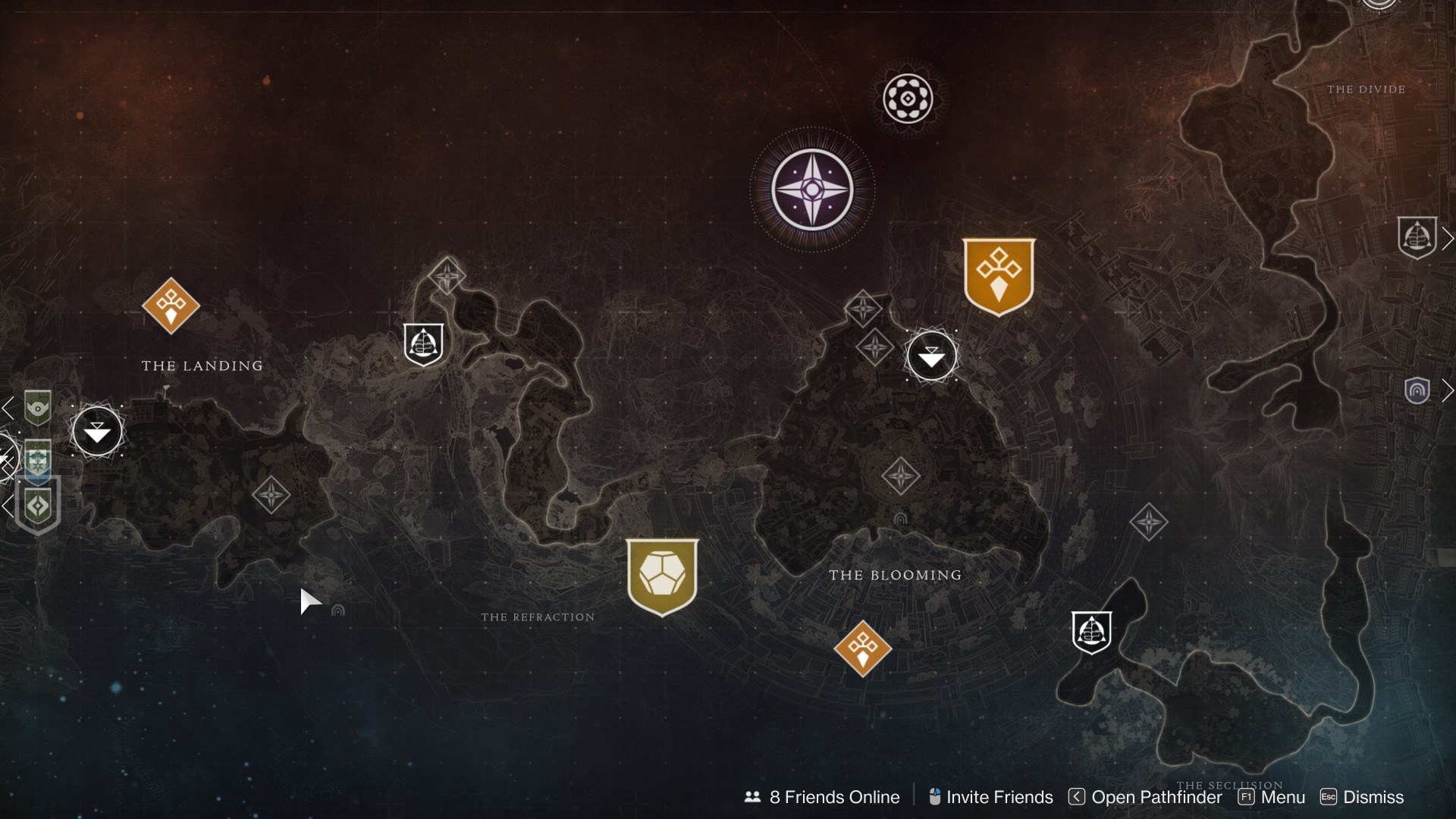
The Pale Heart of the Traveler represented an interesting problem for many disciplines across the Destiny Team: unlike previous open-world-style destinations whose areas interconnected and looped around on themselves, this was intended to be a linear destination fundamentally and profoundly structured around the expansion's campaign.
For the UI Team, this represented a unique challenge: the UI was built around a layered parallax system that drew content closer to the cursor as the cursor moved towards the content, and existing destination maps all used a 16:9 aspect ratio due to technical constraints of this parallax system. Even mouse-based navigation used a lower-magnitude version of this parallax system, with some additional code that allowed the maps to scroll horizontally and vertically when the mouse cursor was outside of a deadzone in the middle of the screen.
Up until this point, it had generally been simple to work within this constraint; most maps only required the addition of minor details outside of the playable space to conform to the 16:9 aspect ratio. The Pale Heart, however, required a long, horizontally-scrolling map which would create significant amounts of “whitespace” above and below the destination's playable area. Looking for a solution, Neon dove deep into documentation and source code for the cursor and parallax systems.
Ultimately, for technical and production reasons, compromises had to be made: players using a mouse were able to stay within a relatively constrained area of the map (saving them the agony of having to scroll for multiple seconds if they found themselves significantly above or below the playable space) while players using a controller would navigate the full 16:9 aspect ratio map (the “whitespace” was filled with clouds to indicate it was not navigable) since deviation from that aspect ratio would create a multitude of minor usability problems and unexpected misses when attempting to navigate the cursor to specific locations. This experience lead Neon to build:
- A playground for designers to experiment with different parallax sizes, aspect ratios, and cursor settings to intuitively feel out the impact of those differences.
- Copious documentation of the different inputs into Destiny 2's cursor and parallax systems: what they did, why they were built that way, and how the underlying code used them.
- A shared understanding between stakeholders which helped avoid this problem space in the future.
- A reputation as “the expert” when it came to cursor and parallax settings.
- Workflow improvements that allowed new maps to be implemented and calibrated faster: a typically week-long process was cut down to a single day, and a map for the game's new seasonal social space was able to be implemented by a second designer with minimal supervision.
Credits
| Visual Design | Dustin Thaxton |
|---|---|
| Technical UI/UX Design | Neon O'Dea |
The Traveler
During the Lightfall release, a smaller version of the Traveler appeared in the Director with a simplified version of the portal carved into it by The Witness, the game's antagonist at the time.
To support its new scale and role as The Final Shape's new destination, The Pale Heart of the Traveler, Neon defined and prototyped the technical approach for this version of the “kaleidoscoping” portal effect (a relatively straightforward reflected UV animation under a mask). Ultimately, other Technical UX Designers handled the final implementation.
This depicts the Pale Heart destination node as it appeared during the following releases: The Final Shape, The Edge of Fate, and Renegades. For the game's final Monument of Triumph release, a new version of this effect was built on an updated shader pipeline.
Credits
| Visual Design | Eric Connor Richter |
|---|---|
| Technical UI/UX Design | Jason Pfitzer (Lightfall implementation), Neon O'Dea (“Kaleidoscope” effect), Jennifer Wilson, Tyler Zwiers |
Pathfinder
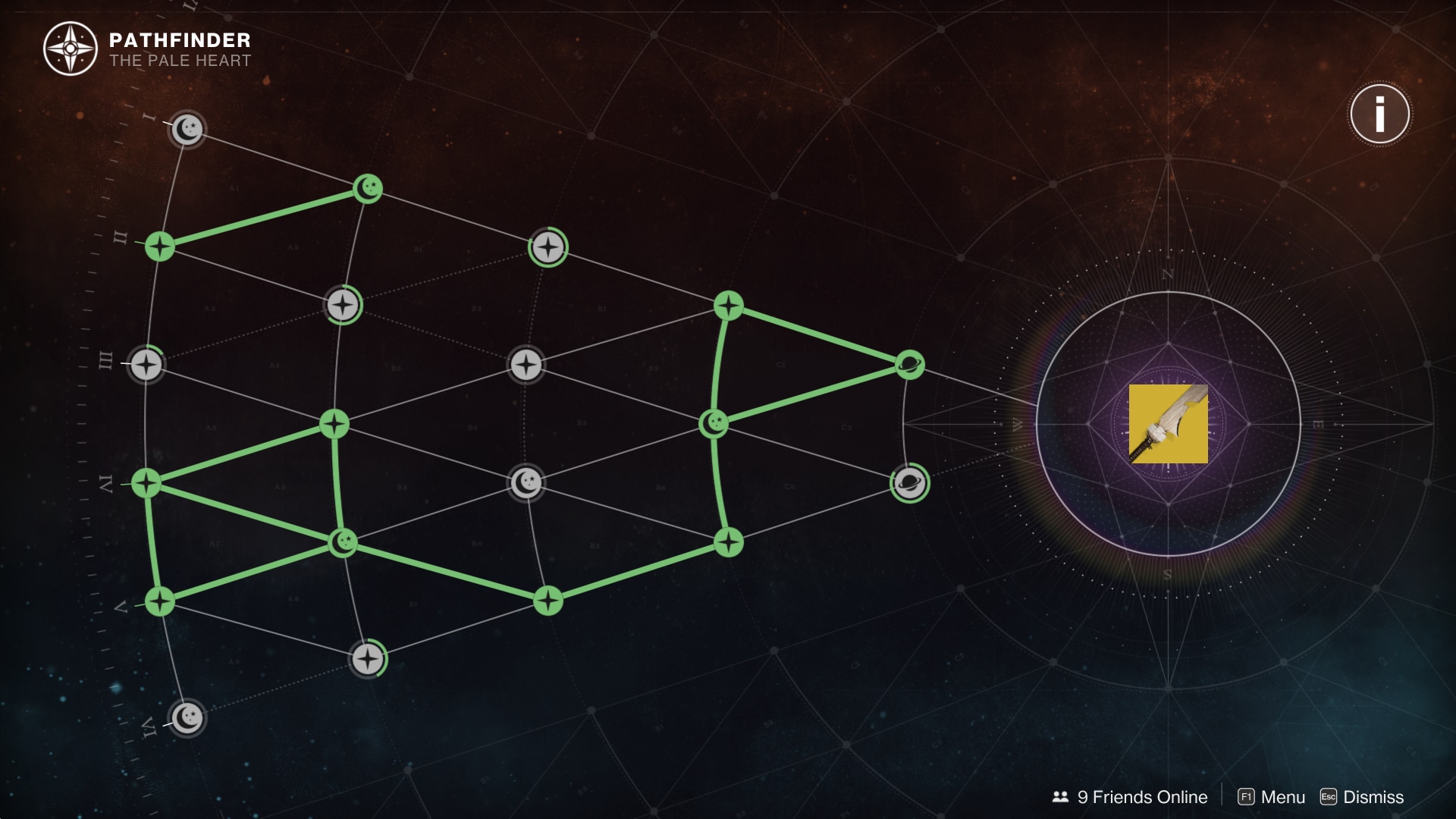
Destiny 2's pursuit systems had problems: acquiring, progressing, and claiming them was inconsistent, often spread across multiple surface areas between the game's UI and world. A “bounty” might require the player to visit the game's social space to acquire it while tracking it in the game's quest log, whereas bite-sized patrol objectives were scattered across destinations and their availability was subject to a seemingly-random time-based rotation.
The Destiny 2 team set out to build a comprehensive system that could replace these disparate systems: first, for the new expansion's destination and, eventually, for all destinations and activity types.
Investigation
The team identified these pain points in existing pursuit systems:
- Acquiring bounties, and claiming progression-based rewards from them, required traveling outside of the primary gameplay area, leading to frequent (and time-consuming) back-and-forth.
- Bounties were stored in a limited “inventory” shared with the game's quest system.
- There was little to no planning or expression to the systems, leaving them feeling more like grinding than anything else.
- Challenges did not increase as you approached goals; they felt more like “grinding” than pursuit.
- Location-based objectives did not show up on the game's maps.
With research in hand, the team shifted to exploring and proposing solutions.
Proposals
The idea that survived brainstorming sessions took into account both the problem space and our engineering constraints: light updates to existing systems to support an interconnected web of bite-sized objectives with minor rewards, and a major reward at the center.
Every week, or voluntarily after the player claimed their final reward, progress would be reset and the web would be randomized to provide the player with a new set of objectives and a new final reward. No need to acquire objectives, no need to leave the play area, no inventory to manage.
Progress toward any objective was always tracked, but claiming their rewards required the objective to be on the outer layer or connected to an objective that had already been completed. Completing a path from the outer layer to the center would unlock the major reward.
Players could take a longer path through the system to avoid an objective they did not like, but as they neared the center they were more likely to be pushed to change up their playstyle or take on a difficult challenge.
Location-based objectives that needed to be completed in specific locations were rendered to the map and could be tracked, allowing players to easily find them using the game's waypointing system.
Early versions of the Pathfinder system only allowed “forward” (towards the center) and “lateral” (along the same layer) movement through the system. Neon argued (and won) the case for allowing “backward” (away from the center) movement, which had two key ramifications:
- Once players got near the center, they could more easily pick up minor rewards for objectives they completed that were not adjacent to their initial path.
- Players who found their path blocked by objectives they did not want to do had more freedom to navigate the web expressively, creating more controlled ways for players to feel like they “got one over” on the designers.
Prototyping
With these plans in mind, Neon began prototyping the rendering techniques to support this interconnected web of objectives. Predicting that the layout of the web itself was likely to fluctuate and possibly differ between use cases for the system, they worked with a UI Engineer to ensure the angle and distance between two components could be calculated on the fly.
With an angle and distance between two components, drawing a straight line (even a dotted one) was no challenge at all. However, there was no straightforward UI tool for rendering the system's signature curved lines, and UI Engineering support was urgently needed on the game's upcoming Fireteam Finder system.
Fortunately, a midnight spark of inspiration over the weekend (followed through on Monday, obviously) enabled Neon to implement an engineering-free solution for rendering the curved lines using a combination of prerendered bitmaps and a lot of position-based calculations to determine UV coordinates in real time.
The system's layout dramatically changed twice over the course of development; as a result of these preparations, the layout changes were executed rapidly each time.
Access
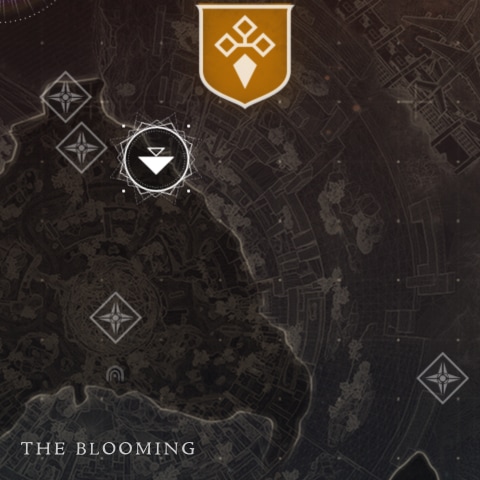
Neon began implementing the tools for players to access Pathfinder: an eye-catching node on destination maps, a hotkey for accessing the system from those maps for players to quickly get in without having to track down the node, and an even quicker access point on mid-gameplay objective complete notifications.
Destiny 2's “Ritual” (repeatable, often playlist-based) activities were accessed from activity selection screens, not maps, which presented a problem: when opening the Director during a Ritual activity (or during its post-activity results flow) the game would display a “No map available” screen instead of a destination map.
The team made minor adjustments to allow the Director, during these activity lifecycles, to show the activity selection screen for the activity type where the node and hotkey could be supported, allowing players to access the Rituals Pathfinder system as conveniently as a destination-based Pathfinder system.
Map Markers
As Fireteam Finder's development neared completion, UI Engineering resources began to free up again. With their help, Neon was able to implement map markers for location-specific objectives, allowing players to track these objectives the same way players could track quests.
Activity Designers were able to use the active status of these objectives as inputs, ensuring that while players engaged with the destination's phase-based “Overthrow” activity it was able to instance challenges related to the players' Pathfinder to help them work toward their objectives.
Test Support
Early on in planning, QA identified that the randomized elements of the design made it difficult to ensure full test coverage for the system's objectives. Neon worked with stakeholders to carve out time—for themselves and a Technical Designer—to execute on a debug tool for QA. The tool presented testers with the full suite of objectives, without any logic gating access to them, allowing them to validate the objectives separately from the system itself.
The existence of this tool eliminated QA's uncertainty and, over development, “[saved] one month of validation time” through the creation of opportunities for automated testing and increased delegation of the bite-sized objectives to execution-focused contract or co-dev testers. Meanwhile, experience-focused testers and in-house QA were able to stay fully dedicated to validating that the overall system was meeting its design goals.
This confidence boost, paired with the process improvements, was not only critical to shipping the Rituals Pathfinder (which needed to port hundreds of existing objectives from other pursuit systems seamlessly without bugs) but also allowed the Rituals team to include and validate objectives from Onslaught—a new activity type that had been added just two months prior to The Final Shape's ship date in Lightfall's Into the Light update—on an incredibly tight timeline.
Results
If you play Destiny 2, you know that Pathfinder did not expand to replace bounties and patrol objectives on every destination. At launch, it supported the new destination and Destiny 2's Ritual activities and, while the former was very well received, the approach the latter took to consolidating the objectives for each of those Ritual activities together into one system was not received as well.
A set of changes were made to the Rituals Pathfinder to split it in three (one for each type of Ritual activity) in the next seasonal release, turning it from a misstep into a huge success. However, major direction changes to the model for Destiny 2's expansions and the structure of its day-to-day gameplay in the game's next expansion, The Edge of Fate, meant that the Rituals Pathfinder was soon retired. As of the game's final Monument of Triumph release, no additional destinations had been updated to use Pathfinder.
Credits
| UI Feature Lead | Phil Etting |
|---|---|
| UX Design | Mai Tsuji, Crystal Talley |
| Visual Design | Dustin Thaxton |
| UI Engineering | Shea Vox |
| Technical UI/UX Design | Neon O'Dea |