The penultimate major release in Destiny 2's Light & Dark Saga, Lightfall brought players to a thriving city on Neptune called Neomuna where remnants of humanity had secretly been hiding for centuries.
Neon started working at Bungie midway through Lightfall's development, contributing to the seasonal release before it, the campaign-focused major release, and the seasonal releases that followed it. These examples show some of their first (non-bugfix) work on Destiny 2. Of particular note is the implementation for the Crota's End raid node, which goes into detail about how its rich visual effects were built.
Neomuna Map
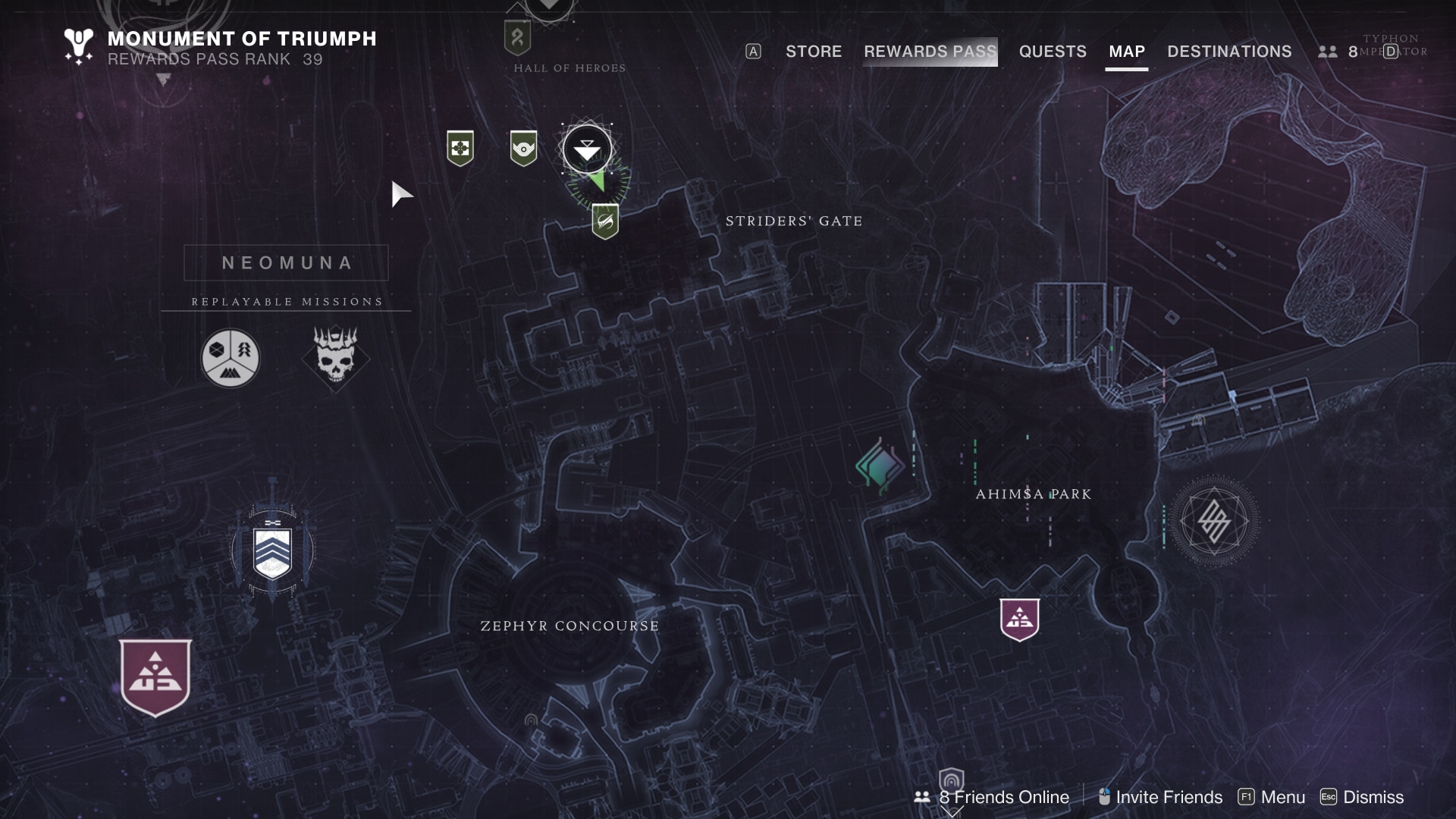
As the lock date for the Lightfall release got nearer and more of the destination team's work was complete, a problem was identified: in a few key areas, the density of in-world locations that needed to be represented on the map was so high that they would consistently overlap in the UI.
To fix this, Neon reauthored the map at a new scale and learned how to recalibrate the matrix used to transform in-world coordinates into UI coordinates to ensure that everything ended up rendered at the right position on the map.
Credits
| Technical UI/UX Design | Jason Pfitzer (Original Implementation), Neon O'Dea |
|---|
Vex Incursion Zone
Neomuna is under constant assault by two different factions. Periodically, that assault will refocus on a different major area of the destination: the Vex Incursion Zone, named and themed after one of the factions attempting to take over the destination.
This visual effect combines masking techniques and UV animations to create a raining data-stream over the contested area. Special care was taken to manage the timing & frequency of the glitch effects to avoid causing harm to players with photosensitivity issues.
Credits
| Visual Design | Eric Connor Richter |
|---|---|
| Technical UI/UX Design | Neon O'Dea |
Terminal Overload
Terminal Overload gives players an ad hoc, coordinated activity which they can stumble across while exploring the destination or launch directly from the Neomuna map. To help players better understand the activity, its node was designed to be reminiscent of The Blind Well activity on the Dreaming City destination from Destiny 2's Forsaken expansion.
The technical approach to this was used in a later release to allow players to directly launch into The Blind Well; previously, players had to access that activity by navigating to it in-game.
Credits
| Visual Design | Eric Connor Richter |
|---|---|
| Technical UI/UX Design | Neon O'Dea |
Root of Nightmares
In the Destiny franchise, raids are highly-coordinated team-based activities designed for 6 players that can take upward of a few hours to complete. The release of a new raid is a major marketing beat for the game, featuring a race for teams to finish the raid; the first team to do so receives real-world rewards. As such, the activity nodes for raids are designed to be larger and more eye-catching than standard activities.
Neon was honored to take on the implementation of this raid node as their very first non-bugfix content work. The motion design on the circular rings pulls the player's eyes inward, deeper and deeper into Nezarec's symbol and the darkness below.
Credits
| Visual Design | Eric Connor Richter |
|---|---|
| Technical UI/UX Design | Neon O'Dea |
Featured Quests
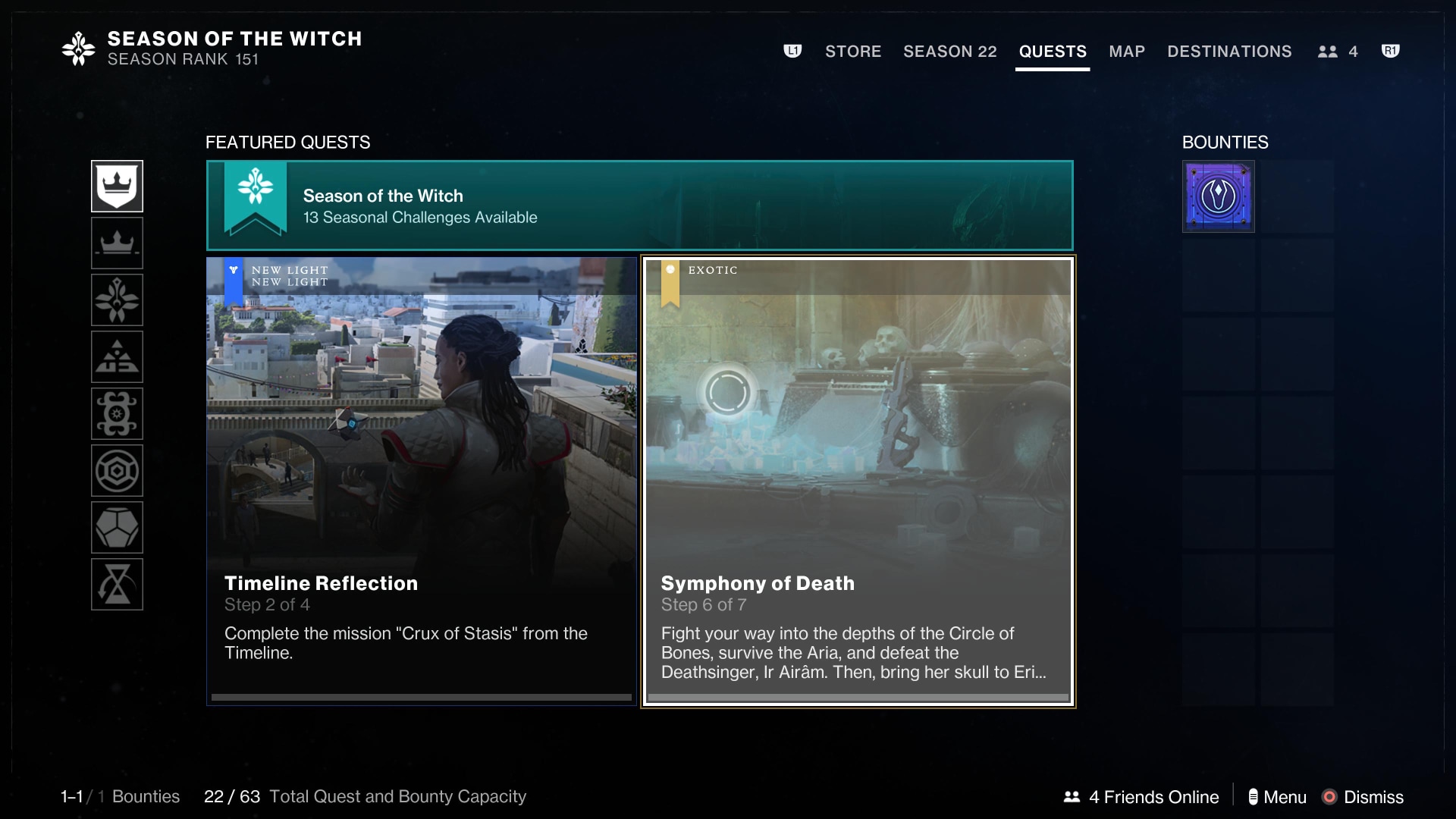
Like most RPGs, Destiny 2 has a large number of quests. This introduced a challenge: while there was some visual separation provided for Exotic quests (which provided players with powerful, build-defining weapons known as “Exotic weapons”), most quests—including critical campaign quests for unlocking abilities and progressing the game's story—looked pretty much the same. For new and returning players, especially, it was difficult to understand how to get up to speed in the game.
For the Lightfall year's Season of the Witch release, Neon's team set out to improve this with the implementation of a “Featured Quests” view: a section of the game's Quest screen which surfaced large, eye-catching panels for important and sometimes-time-sensitive quests. To appear in this interface, quests had to meet certain criteria: they needed to be part of the game's New User Experience, reward the player with an Exotic weapon, or be the primary quest for the core storyline of an expansion, seasonal release, or seasonal events.
Neon's prototype of this system helped the team hone in on a visual direction, prove out technical approaches, and understand where existing tools were insufficient for the problem space; this was crucial to inform engineering where work needed to be planned, scoped, and executed. Afterwards, implementation was handed off to other Technical UX Designers while Neon focused on building the Pathfinder system for the game's next release, The Final Shape.
Credits
| UX Design | Crystal Talley |
|---|---|
| Visual Design | Eric Connor Richter |
| UI Engineering | Basil Elhindi |
| Technical UI/UX Design | Neon O'Dea (Prototype), Tyler Zwiers, Jennifer Wilson |
Exotic Mission Rotator
Destiny 2's seasons and their associated activities were removed with every major release, creating a problem: there was no longer a way to acquire the Exotic Weapons granted by their Exotic Missions.
In Destiny 2's Season of the Witch, the team added the Exotic Mission Rotator: every week, a no-longer-available Exotic Mission would be featured and players could complete it to collect its rewards.
Neon conducted an internal livestream to Destiny 2's UI Team for the implementation of this node. This increased awareness of the capabilities of the proprietary engine's UI tools, which directly resulted in improvements to asset pipelines & workflows for the rest of the game's development.
Credits
| Visual Design | Dustin Thaxton |
|---|---|
| Technical UI/UX Design | Neon O'Dea |
Crota's End
For Destiny 2's Season of the Witch, the Raids and Dungeons team crafted their reprisal of the Crota's End raid from Destiny 1. Raid reprisals in Destiny 2 lived in its “Legends” screen, and received lavish visual treatments that were more detailed, colorful, and technical than most activity nodes and even other raid nodes.
Neon crafted all of the motion design for this node, collaborating with their Visual Designer to ensure it did not overwhelm or otherwise diminish the node's visual design. In particular, they built its shimmering radial, the VFX for the flames pouring out on hover, and the glowing ember effect on the ring of Hive lights.
Radial
Because this node was large, sat in the center of the screen, and featured connections between the radial and body, Neon and their visual designer wanted to avoid making its radial guide the eye to either side of the screen using Destiny 2's standard radial rotation.
To create a sense of motion while preserving connections and maintaining screen balance, Neon crafted a subtle, shimmering effect by applying a mask to a rotating smoke texture.
| Timecode 00:00–00:10 | The radial, used as a mask for the VFX |
|---|---|
| Timecode 00:10–00:20 | The rotating smoke texture, without masking |
| Timecode 00:20–00:30 | The final, masked VFX |
Flame VFX
Green flames, especially in a circular motif, are a visual touchstone of the Hive faction in the Destiny universe, derived from the use of ritual circles in their magic.
This effect was achieved by masking 8 rotations & offsets of a simple UV animation. When the player's cursor goes over the node, flames pour out from the edge of the circle.
| Timecode 00:00–00:10 | The spiked, circular mask for the VFX |
|---|---|
| Timecode 00:10–00:20 | The underlying UV animation of flames scrolling in 8 directions, without masking |
| Timecode 00:20–00:30 | The final, masked VFX |
Hive Lights
These lights are another motif repeated throughout Hive-themed areas of the game, including within the Crota's End raid. For the node, they've been adapted into a circular format by applying a polar coordinate transformation to them.
This effect was achieved by masking a shader that rendered portions of an image when an RGBA channel value was between two specified values. When the player's cursor goes over the node, the embers of these lights burn with greater intensity.
| Timecode 00:00–00:10 | The circular Hive lights motif mask for the visual effect |
|---|---|
| Timecode 00:10–00:20 | The base image being used by the shader to get RGBA channel values |
| Timecode 00:20–00:30 | The shader output, without masking. A “center” channel value is animated over time, while a “deviation” value (used to determine the floor and ceiling provided to the shader) increases on hover |
| Timecode 00:30–00:40 | The shader output, with masking |
| Timecode 00:40–00:50 | The final, masked VFX with an additional copy of the circular Hive lights motif placed under it to give additional body to the effect |
Credits
| Visual Design | Dustin Thaxton |
|---|---|
| Technical UI/UX Design | Neon O'Dea |
Into the Light
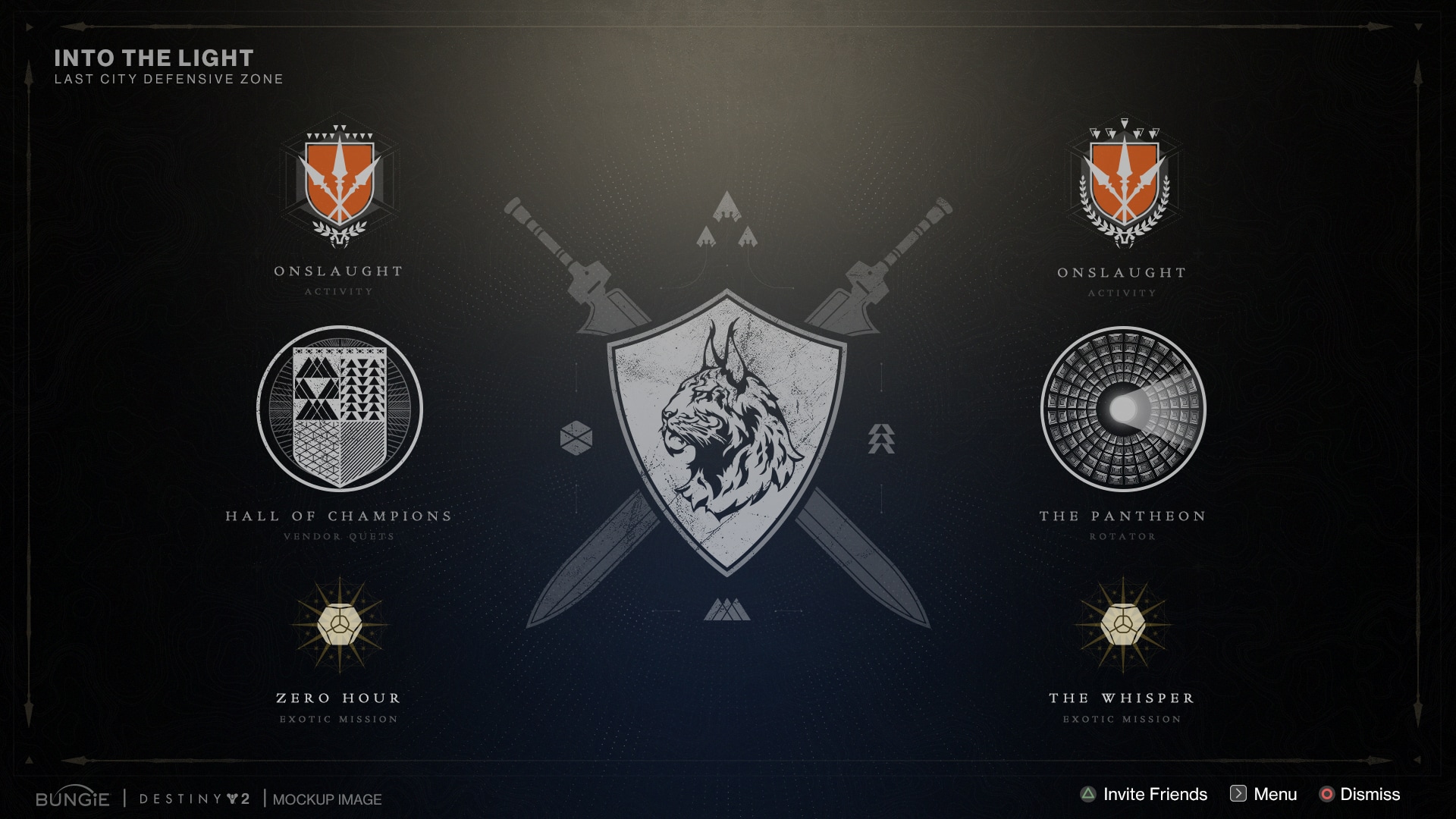
To give time and space to the teams working directly on the campaign and sandbox experience for Destiny 2's next major release, The Final Shape, to really cook, its release date needed to be pushed back. The decision was made to fill this new gap with a miniature release titled Into the Light.
Due to the compressed development schedule, work needed to be completed quickly: Neon moved fast to plan out the parallel development strategy for the release's primary screen so that three Technical UX Designers could execute together. Then, they focused on implementing the screen's lighting effects, animations, border, parallax, and point of entry in the Director while others implemented the Onslaught, Hall of Champions, and Pantheon nodes for the release's new activities.
Credits
| Visual Design | Dustin Thaxton |
|---|---|
| Technical UI/UX Design | Neon O'Dea, Tyler Zwiers |